
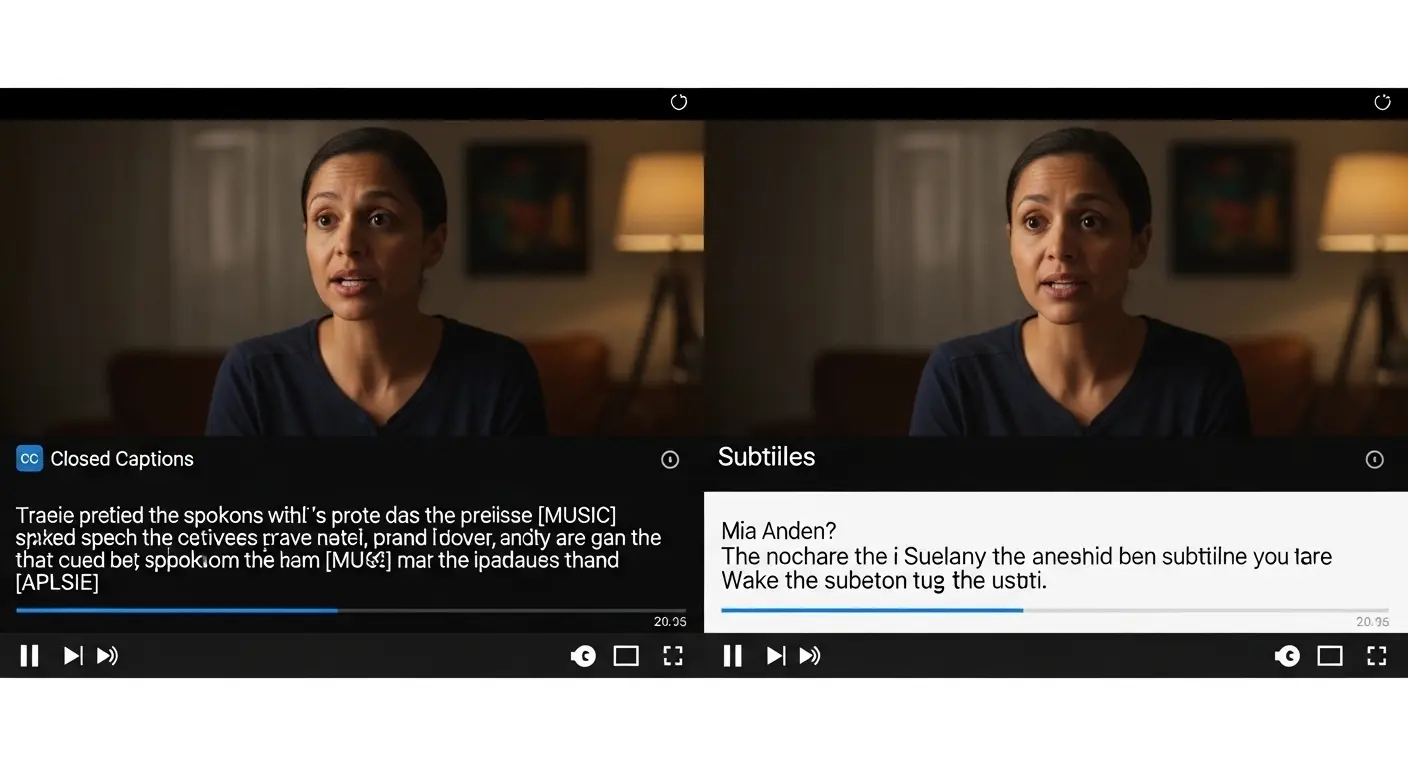
If you’ve ever paused Netflix, opened YouTube settings, or uploaded a video to Instagram, you’ve probably asked yourself: what’s the difference between closed captions and subtitles?
Here’s the simple, featured-snippet-ready answer:
Closed captions (CC) are designed for deaf and hard-of-hearing viewers and include all audio information—dialogue, sound effects, speaker identification, and music cues. Subtitles are primarily for viewers who can hear the audio but need translation or help understanding spoken language.
That’s the core difference.
But oh babe… there’s so much more nuance hiding behind those tiny lines of text at the bottom of your screen.
In this in-depth guide, we’ll break down everything you need to know about closed captions vs subtitles—from definitions and legal standards to streaming platforms, accessibility, SEO, content creation, and even emotional psychology. Whether you’re a content creator, marketer, business owner, educator, or curious binge-watcher, this guide is your complete resource.
Let’s dive in.
1. What Are Closed Captions?
Closed captions are on-screen text representations of all audio content in a video.
They include:
-
Spoken dialogue
-
Speaker identification
-
Sound effects (e.g., [door slams])
-
Music cues (e.g., [romantic music playing])
-
Background noises (e.g., [crowd cheering])
Closed captions are specifically designed for deaf and hard-of-hearing audiences, making video content fully accessible.
The word “closed” means viewers can turn them on or off. They’re not permanently embedded into the video.
Closed captions don’t just tell you what was said. They tell you what was heard.
2. What Are Subtitles?
Subtitles are text versions of spoken dialogue only.
They typically:
-
Show spoken words
-
Translate foreign languages
-
Do not include sound effects
-
Rarely identify speakers (unless needed)
Subtitles are meant for:
-
Viewers watching content in another language
-
People who understand spoken audio but need visual support
-
Quiet environments where volume is off
If closed captions are about accessibility, subtitles are about language comprehension.
3. The Core Difference Between Closed Captions and Subtitles
Let’s simplify the answer to what’s the difference between closed captions and subtitles:
| Feature | Closed Captions | Subtitles |
| Designed For | Deaf & hard-of-hearing viewers | Viewers who can hear |
| Includes Dialogue | Yes | Yes |
| Includes Sound Effects | Yes | No |
| Includes Music Cues | Yes | Rarely |
| Speaker Identification | Yes | Usually no |
| Accessibility-Focused | Yes | Not primarily |
In one sentence:
Closed captions include everything you hear. Subtitles include only what’s spoken.
4. Why Closed Captions Exist: Accessibility First
Closed captions were created to ensure equal access to media.
For millions of deaf and hard-of-hearing individuals worldwide, captions aren’t optional. They are essential.
Without captions:
-
TV becomes silent storytelling.
-
Movies lose emotional context.
-
Educational content becomes inaccessible.
-
Emergency broadcasts become dangerous.
Closed captions ensure:
-
Inclusion
-
Legal compliance
-
Equal digital participation
Accessibility isn’t a bonus feature. It’s a responsibility.
5. Why Subtitles Exist: Language & Globalization
Subtitles emerged to solve a different problem: language barriers.
Think about:
-
Korean dramas watched in the U.S.
-
Spanish films streamed in Europe
-
International business webinars
-
Online courses with global students
Subtitles allow content to cross borders.
They support:
-
Multilingual audiences
-
Cultural exchange
-
International business growth
-
Global streaming platforms
Subtitles are about expanding reach. Closed captions are about ensuring access.
6. Open Captions vs Closed Captions (Important!)
Here’s where confusion often happens.
Open captions:
-
Are permanently embedded in the video
-
Cannot be turned off
-
Often used on social media
Closed captions:
-
Can be toggled on/off
-
Are stored as a separate file
Many Instagram and TikTok videos use open captions because:
-
80%+ of users watch with sound off
-
It increases engagement
-
It boosts watch time
So when creators say “subtitles” on Instagram, they often actually mean open captions.
Yes, terminology gets messy.
7. Legal Requirements for Closed Captions
In many countries, closed captions are legally required.
In the United States:
-
FCC mandates captions for broadcast TV
-
ADA supports accessibility standards
-
Online content from broadcasters must include captions
Failure to provide captions can result in:
-
Lawsuits
-
Compliance fines
-
Brand damage
Subtitles are rarely legally required. Closed captions often are.
8. Technical Differences: File Formats Explained
Closed captions and subtitles use different file formats.
Common caption formats:
-
.SRT
-
.VTT
-
.SCC
-
.DFXP
Closed captions:
-
Include timing and metadata
-
May include formatting codes
Subtitles:
-
Typically include dialogue + timing
-
Less metadata complexity
Creators uploading to YouTube or Vimeo will notice settings labeled:
-
“Subtitles”
-
“CC”
Now you know the difference.
9. Do Closed Captions Help SEO?
Yes. Absolutely.
Here’s why:
Search engines cannot watch videos.
They read text.
When you upload:
-
Transcripts
-
Caption files
-
Subtitle files
You’re giving search engines searchable content.
Benefits:
-
Higher rankings
-
More keyword indexing
-
Improved discoverability
-
Better YouTube SEO
Captions boost accessibility and visibility.
That’s a powerful combination.
10. Do Subtitles Improve Engagement?
Studies show that videos with captions (even when sound is on):
-
Increase watch time
-
Improve comprehension
-
Boost retention
-
Increase completion rate
Even hearing audiences:
-
Prefer captions in noisy spaces
-
Use subtitles for clarity
-
Watch longer with text support
So while subtitles aren’t built for accessibility, they still increase engagement.
Creators who ignore captions lose reach.
11. Closed Captions and Emotional Context
Here’s something most guides don’t talk about.
Captions carry emotion.
Example:
Subtitles:
I love you.
Closed captions:
I love you.
[voice trembling]
See the difference?
Sound effects and tone indicators add:
-
Emotional depth
-
Narrative clarity
-
Character intention
Closed captions protect storytelling integrity.
12. Real-Time Captions vs Pre-Recorded Captions
There are two main types:
1. Real-Time (Live) Captions
-
Used in live broadcasts
-
Generated by human stenographers or AI
-
Can contain errors
2. Pre-Recorded Captions
-
Created after filming
-
More accurate
-
Professionally edited
Subtitles are usually pre-produced.
Live captions matter in:
-
Webinars
-
Zoom meetings
-
News broadcasts
-
Live events
Accessibility doesn’t pause for live content.
13. Automatic Captions vs Human Captions
AI-generated captions are improving, but:
Common AI errors:
-
Misheard names
-
Incorrect punctuation
-
Missing sound descriptions
-
No speaker labels
Human captions:
-
99%+ accuracy
-
Context-aware
-
Emotionally accurate
If you’re a brand or educator, invest in accuracy.
Accessibility deserves precision.
14. Multilingual Subtitles vs Closed Captions
Here’s a subtle but important distinction.
Subtitles:
-
Frequently translated into multiple languages
-
Focus on dialogue only
Closed captions:
-
Usually in the original language
-
Include full audio detail
You can have multilingual closed captions, but it’s less common.
If your goal is global growth → subtitles.
If your goal is accessibility compliance → closed captions.
15. Social Media and the Confusion Around “Subtitles”
On TikTok, Instagram, and YouTube Shorts, creators often say:
“Turn on subtitles!”
But what they usually mean:
-
On-screen text
-
Auto-generated captions
-
Styled open captions
Technically, many of these are:
-
Open captions
-
Or simplified subtitles
Social media has blurred the line between terminology.
But the technical difference still matters—especially in professional settings.
16. Closed Captions in Education
In educational environments, closed captions:
-
Improve learning outcomes
-
Help ESL students
-
Support neurodivergent learners
-
Increase information retention
Even students who are not deaf:
-
Comprehend complex topics better with captions
-
Review material faster
-
Take notes more efficiently
Accessibility improves everyone’s experience.
17. Subtitles in Film and Entertainment
Subtitles transformed global entertainment.
Without subtitles:
-
Parasite wouldn’t have won global awards
-
Anime wouldn’t dominate Western streaming
-
International cinema wouldn’t thrive
Subtitles create:
-
Cultural bridges
-
Emotional universality
-
Global fandoms
They are a quiet powerhouse of globalization.
18. Common Myths About Closed Captions and Subtitles
Let’s clear this up.
Myth 1: They’re the same thing.
→ Not true.
Myth 2: Only deaf people use captions.
→ Millions of hearing users use them daily.
Myth 3: Subtitles include sound effects.
→ Typically no.
Myth 4: Captions reduce cinematic quality.
→ Studies show they increase comprehension and engagement.
Clarity doesn’t reduce beauty. It enhances it.
19. When Should You Use Closed Captions?
Use closed captions when:
-
You want full accessibility
-
You’re legally required to provide them
-
You’re in education or public broadcasting
-
You’re creating inclusive content
-
You want maximum SEO benefit
If inclusion matters to your brand—captions aren’t optional.
20. When Should You Use Subtitles?
Use subtitles when:
-
Translating content
-
Expanding internationally
-
Sharing multilingual webinars
-
Distributing films globally
-
Creating language-learning content
Subtitles expand your audience across borders.
21. Which Is Better: Closed Captions or Subtitles?
It’s not about better.
It’s about purpose.
Closed captions = Accessibility
Subtitles = Translation & language support
The smartest creators use both.
22. Quick Summary: What’s the Difference Between Closed Captions and Subtitles?
Let’s wrap it in one clean answer:
-
Closed captions include all audio elements.
-
Subtitles include spoken dialogue only.
-
Closed captions are accessibility-driven.
-
Subtitles are language-driven.
-
Both improve engagement and discoverability.
Now when someone asks what’s the difference between closed captions and subtitles, you can explain it confidently.
FAQ: Closed Captions vs Subtitles
1. Are closed captions the same as subtitles?
No. Closed captions include dialogue and non-speech audio. Subtitles usually include dialogue only.
2. Which is required by law?
Closed captions are legally required in many broadcast and public content scenarios. Subtitles are not typically mandated.
3. Do subtitles help deaf viewers?
Not fully. They lack sound effect and speaker context needed for full accessibility.
4. Are YouTube captions closed captions?
Yes, YouTube offers closed captions (CC) that can be turned on or off.
5. Why do some captions say [music playing]?
That’s a feature of closed captions, designed for deaf and hard-of-hearing viewers.
6. Do captions help with SEO?
Yes. Caption files provide crawlable text for search engines.
7. What does “CC” mean on TV?
It stands for Closed Captioning.
8. Can subtitles be translated automatically?
Yes, many platforms offer auto-translation for subtitles.
9. Are open captions the same as closed captions?
No. Open captions are permanently embedded. Closed captions can be toggled on or off.
10. Should businesses use both?
Yes. Closed captions for accessibility, subtitles for international growth.
Final Thoughts
It’s not just technical. It’s philosophical.
Closed captions are about inclusion.
Subtitles are about connection across languages.
One ensures no one is left out.
Add captions. Add subtitles. Expand access. Expand reach.
And the next time someone casually mixes them up?
